

Ear Training for Beginners: What It Is and How to Start
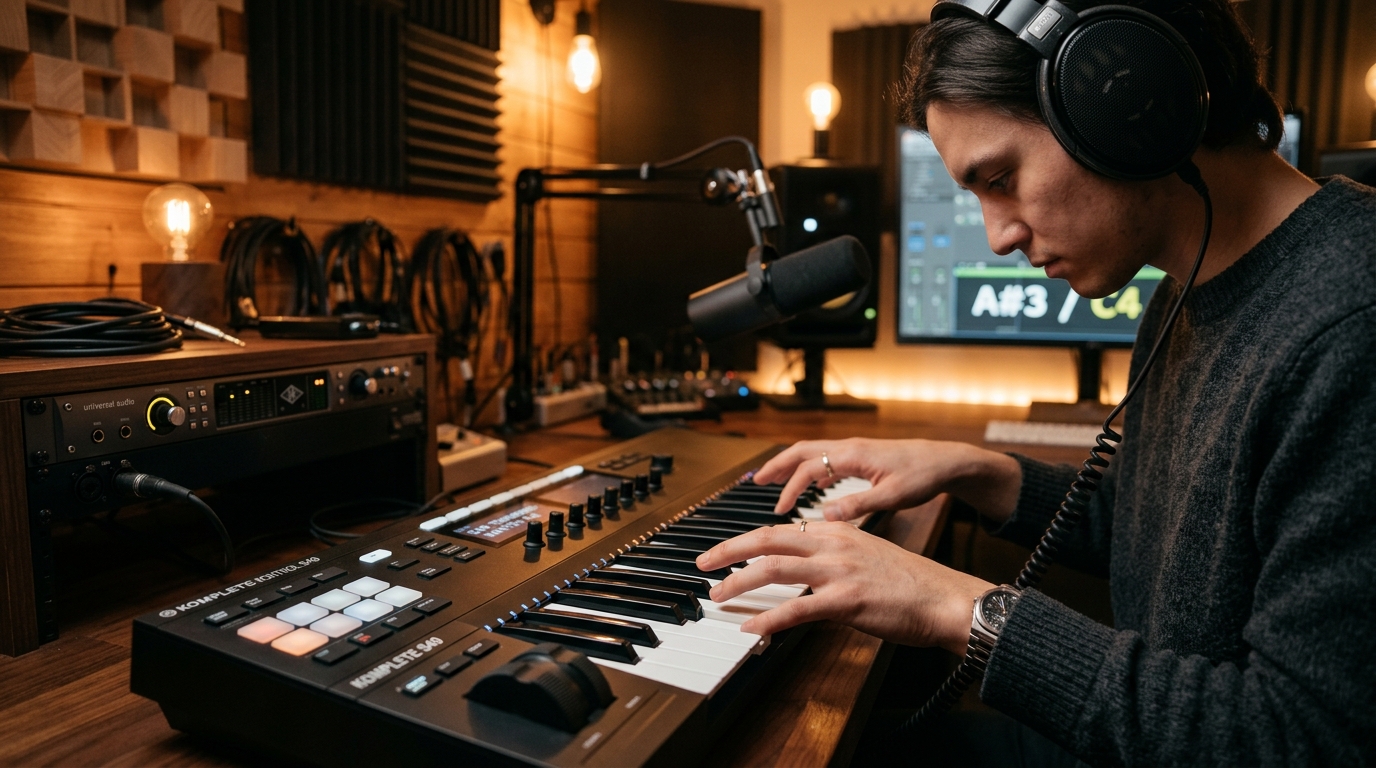
Have you ever watched a musician hear a song on the radio and immediately play it back on their instrument without looking at sheet music? It looks like magic. But it’s not magic, and it’s not a rare genetic gift. It’s a skill, and it’s one you can learn. If you're looking into ear training for beginners, you're about to unlock the most important tool in your musical toolbox: your hearing.
Many new musicians spend all their time looking at their hands or staring at sheet music, completely ignoring what their ears are doing. But music is an auditory art form. Ear training bridges the gap between the music you hear in your head and the notes you play on your instrument.
What Is Ear Training?
Ear training is the process of connecting music theory (notes, intervals, chords, and scales) with the sounds you actually hear. It’s learning to recognize musical elements by ear and identify them by name.
Think of it like learning a spoken language. When you hear the word "apple," you don't just hear random sounds; you instantly picture the fruit. Ear training does the same thing for music. When you hear a major chord, your brain instantly says, "That's a major chord," without needing to see the piano keys or the guitar fretboard.
Most people get this wrong the first time because they think they need "perfect pitch" to do this. You don't. You need relative pitch.
Perfect Pitch vs. Relative Pitch
Perfect pitch (or absolute pitch) is the rare ability to hear a single note out of nowhere and name it instantly ("That car horn is an F sharp"). It’s mostly developed in early childhood and is very difficult to learn as an adult.
Relative pitch is the ability to identify notes, intervals, and chords based on their relationship to a reference note. If I play a C, and then play a G, you can learn to recognize that the distance between them is a "perfect fifth." This is how 99% of professional musicians operate. Relative pitch practice is highly trainable, incredibly useful, and exactly what ear training focuses on.
Why Does Ear Training Matter?
If you skip ear training, you will always be dependent on sheet music, tabs, or someone else telling you what to play. Developing your ear opens up entirely new ways to interact with music.
- You can play by ear. When you hear a melody in your head, you’ll know exactly where to find it on your instrument without guessing.
- You can improvise with confidence. You’ll anticipate what a note will sound like before you play it.
- You’ll tune faster and more accurately. Identifying when a string is slightly sharp or flat becomes second nature, making tools like our Acoustic Analyser or Guitar Tuner even more effective.
- You'll learn songs much faster. Instead of painstakingly reading every note, you'll hear a progression and think, "Ah, that's just a I-IV-V progression."
Ear Training for Beginners: The Core Elements
Ear training is usually broken down into a few distinct categories. If you're wondering how to learn ear training effectively, it's best to tackle these one at a time.
1. Pitch Matching (The Absolute Basics)
Before you can identify intervals or chords, you need to be able to hear a single note and sing or hum it back accurately. If you can't match a pitch with your voice, your brain hasn't fully internalized the sound.
Pro tip: You don't need to be a good singer to do this. Your voice is just a diagnostic tool to prove to your brain that you are hearing the exact frequency. If you struggle with this, our Vocal Range Finder can help you visually confirm you are hitting the right notes.
2. Music Interval Training
An interval is the distance between two notes. This is the absolute core of relative pitch. Just like the rungs on a ladder, every interval has a distinct "flavor" or character.
For example, a minor second (playing two adjacent keys on a piano) sounds tense and scary, like the Jaws theme. A perfect fifth sounds open and heroic, like the Star Wars theme.
Music interval training involves listening to two notes played sequentially (melodic intervals) or simultaneously (harmonic intervals) and identifying the distance between them. Start with the easiest ones: the octave, the perfect fifth, and the major third.

3. Chord Recognition
Once you can identify intervals, you can start identifying chords. A chord is just three or more notes played together.
Begin by learning to distinguish between Major and Minor chords. Major chords generally sound happy, bright, or stable. Minor chords usually sound sad, dark, or moody. Once you have those down, you can move on to diminished (tense, scary) and augmented (dreamy, unresolved) chords.
If you want a deeper dive into how these chords are constructed, check out our guide on Major vs. Minor Chords.
4. Chord Progressions
This is where it all comes together. Instead of identifying a single chord in isolation, you learn to hear how chords move within a key. Popular music uses the same few chord progressions repeatedly. Once you train your ear to recognize a I-V-vi-IV progression (the basis of hundreds of pop hits), you can learn those songs almost instantly.
The Most Common Ear Training Mistake
The biggest mistake beginners make is treating ear training like a purely academic exercise. They use an app for 10 minutes, get a perfect score on identifying a "perfect fourth," and then never apply it to their instrument.
Ear training must connect to your physical playing. If you learn to hear a major third, you must also know what a major third looks and feels like on your guitar fretboard or piano keyboard. Always bridge the gap between the app and the instrument.
Try This Now: The Reference Song Trick
You can start training your ear today using songs you already know. We associate different intervals with the first two notes of famous melodies.
- Minor 2nd: The Jaws theme song.
- Major 2nd: "Happy Birthday" (Hap-py)
- Perfect 4th: "Here Comes the Bride" (Here comes...)
- Perfect 5th: The Star Wars main theme.
- Major 6th: The NBC chime logo.
- Octave: "Somewhere Over the Rainbow" (Some-where)
Go to your instrument. Play a C. Now, try to sing a perfect fifth above it by thinking of the Star Wars theme. Then, play a G on your instrument to see if you were right. You are now doing ear training!
Frequently Asked Questions About Ear Training
Do I need to be able to sing to do ear training?
No, you don't need a "good" voice or to be a trained singer. Singing or humming is simply a physical way to prove to your brain that you are correctly hearing a specific frequency. Even if your voice is rough, as long as you match the pitch, the ear training is working.
How long does it take to learn relative pitch?
Most beginners notice significant improvements within a few weeks of consistent, daily practice (even just 5-10 minutes a day). Developing a highly advanced ear capable of recognizing complex jazz chords might take years, but the basic ability to identify major/minor chords and simple intervals happens much faster.
Can I learn ear training on my own?
Yes! While having a teacher can help point out mistakes, there are countless free apps, videos, and online exercises designed specifically for self-taught musicians. The most important thing is combining app-based learning with actual practice on your instrument.
Your Next Steps
Ear training for beginners is all about consistency. Five minutes a day is vastly better than an hour once a week.
Start by humming notes you play on your instrument. Then, move on to recognizing major versus minor chords. From there, begin music interval training using the reference song trick above. For interactive practice, we highly recommend musictheory.net's ear training exercises.
If you're ready to get your instrument perfectly in tune before you start practicing your pitch matching, use our free Chromatic Tuner. And if you want to understand the scales that these intervals are built from, read our primer on What Are Music Scales. Your ears are your most powerful musical asset — it's time to start using them.