

How to Improve Your Singing Voice at Home: A Practical Guide
If you've ever recorded yourself singing in your bedroom only to immediately cringe and hit delete, you aren't alone. Most people assume they either have a "good voice" or a bad one. In reality, learning how to improve your singing voice at home is mostly about undoing bad habits and learning how to use the physical instrument inside your body. You don't need a professional studio or an expensive coach to make significant progress.
The key to singing better fast isn't pushing harder or buying a nicer microphone. It's about building muscle memory, improving breath support, and developing your ear. Let's walk through exactly what you should be doing in your practice sessions.
How to Improve Your Singing Voice at Home: The Foundation
Before you sing a single note, you need the right setup. You can't improve if you're hunched over your laptop on a soft mattress.
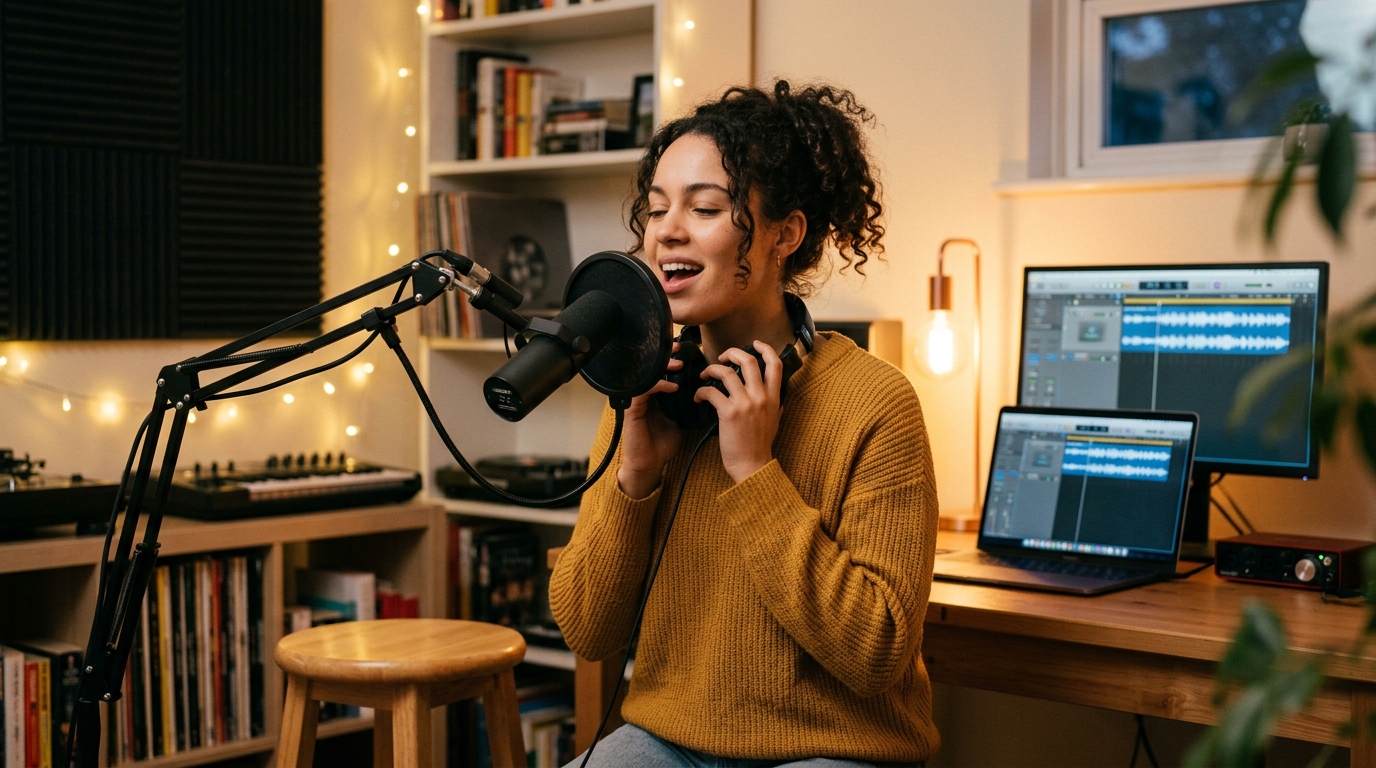
Stand up. Keep your feet shoulder-width apart, your knees slightly bent, and your chest lifted but relaxed. Your neck should be straight, not craning forward like you're trying to reach the note. If you must sit, sit on the edge of a firm chair. Proper posture allows your lungs to expand fully and prevents tension from creeping into your throat.
Start with Gentle Vocal Warm Ups for Beginners
Never skip the warm-up. Just like you wouldn't sprint without stretching, you shouldn't belt out high notes without waking up your vocal cords.
Pro tip: If your throat feels scratchy or tight while warming up, you are pushing too hard. Back off the volume immediately.
Try This Now: The Lip Trill
This is the most effective way to warm up without strain. Take a deep breath and blow the air out through relaxed lips, making them flap together like a horse or a boat motor ("brrrrr").
- Start by just making the air flow consistently.
- Once your lips are vibrating easily, add a comfortable, mid-range pitch.
- Slowly slide your pitch up and down like a siren, maintaining the lip trill.
This exercise forces your vocal cords to connect evenly while keeping your jaw and throat completely relaxed. Do this for two to three minutes every day before you sing actual words.
Master Breath Support
When people ask how to improve vocal pitch accuracy, the answer is often breath support, not the vocal cords themselves. If your air pressure drops, your pitch drops.
When you breathe in, your belly should expand outward. When you exhale (or sing), your belly should pull slightly inward. Most beginners do the exact opposite — their chest heaves up and their shoulders rise on the inhale. That creates tension and gives you very little air to work with.
Try This Now: The Hissing Drill
- Place a hand on your stomach.
- Inhale deeply through your nose, feeling your stomach push your hand out. Your shoulders should not move.
- Exhale slowly on a continuous "Sssss" sound.
- Try to keep the hiss steady and even for 10-15 seconds. Don't let it start strong and fizzle out.
Practice Daily Singing Exercises
Once you're warmed up and breathing correctly, it's time for daily singing exercises. The goal here is consistency. Practicing for 15 minutes a day is far more effective than singing for three hours once a week.

The 5-Tone Scale
Find a piano or use a free piano app on your phone. Find middle C.
- Play five notes going up (C, D, E, F, G) and back down (F, E, D, C).
- Sing along using the vowel sound "Ah" or "Oo."
- Focus on making the transition between notes smooth. Don't slide lazily between the pitches, but don't aggressively chop them up either.
- Move up one key and repeat.
If you have trouble matching pitch, try recording yourself during this drill. You might think you're hitting the notes when you aren't. Hearing it back will quickly train your ear to recognize the difference.
What to Do If Your Voice Cracks
Voice cracks happen to everyone. They usually occur when you're crossing from your chest voice into your head voice. The mistake most beginners make is tensing up and pushing harder to force the note out.
Instead, when you feel a crack coming, sing quieter. Let the voice flip naturally into a lighter sound. The more you fight the break in your voice, the more obvious it becomes. Over time, practicing sirens (sliding from your lowest note to your highest note on an "Oo" vowel) will smooth out this transition.
Frequently Asked Questions
Can anyone learn to sing better?
Yes. Unless you are tone-deaf (amusia), which affects a very tiny percentage of the population (Wikipedia on Amusia), singing is a learned physical skill. Like learning to ride a bike or type on a keyboard, your brain and muscles just need repetition to figure out the coordination.
How long does it take to see improvement?
If you practice focused, 15-minute daily singing exercises, you can start feeling a difference in breath support and pitch accuracy within a few weeks. Developing significant range and tone takes several months of consistent work.
Do I need a microphone to practice?
No. In fact, practicing without a microphone is better for beginners because it forces you to listen to the raw, unedited sound of your voice bouncing off the walls of your room.
Your Next Steps
Stop judging your voice based on how you sing along to the car radio. Your next step is to set a daily alarm for a 15-minute home vocal training session. Start tomorrow. Spend 5 minutes on lip trills, 5 minutes on breath support, and 5 minutes on the 5-tone scale.
Once you get comfortable with matching pitches, check out our guide on understanding your vocal range to discover where your voice naturally shines.