

What Is Music Theory? A Beginner's Plain-English Guide
If you've ever watched a musician effortlessly jam with a band without looking at a single piece of paper, you might assume they just have a magic gift. You might also find yourself wondering, what is music theory, and do I actually need to learn it? The truth is, that musician isn't relying on magic. They are relying on a system. Music theory is simply the language musicians use to understand and communicate how that system works.
Most beginners hear the word "theory" and immediately picture boring classrooms, dusty textbooks, and complicated math. But at its core, theory is intensely practical. It's the "why" behind the music you already love.
Let's break down exactly what this means and how you can actually use it.
So, What Is Music Theory Exactly?
Think of music theory as the grammar of music. When you speak English, you don't actively think about nouns, verbs, and dangling participles before every sentence. You just talk. But if you want to write a compelling novel or learn a second language, knowing the rules of grammar makes the process much faster.
Music theory is the set of rules that explains why certain notes sound good together and why others clash. It gives names to the sounds you hear. When a sad song makes you cry, theory explains that it's likely using a minor key. When a pop chorus gets stuck in your head, theory explains the chord progression that created that catchy loop.

It's important to remember that theory didn't invent music. People were making music long before anyone wrote down a scale. Theory is just how we observe, label, and organize the sounds that naturally exist.
Why Learn Music Theory if You Just Want to Play?
If you're just starting out, you might be tempted to skip theory entirely and just look up tabs or chords online. That works for a while, but eventually, you will hit a wall. Here is why learn music theory even if your goal is just to play for fun:
- You learn songs much faster. Instead of memorizing 50 random piano keys to play a song, you learn that the song is just four chords repeating. It turns a massive memorization task into a simple pattern.
- You can communicate with other musicians. If you are jamming with a bass player and they ask, "What key are we in?", saying "I'm playing the third fret on the thick string" is confusing. Saying "We are in G major" instantly puts everyone on the same page.
- You can fix your own mistakes. When you write a song and it sounds slightly "off," theory tells you exactly which note is causing the friction and how to resolve it.
How to Learn Music Theory Basics Without Getting Overwhelmed
The biggest mistake beginners make is trying to learn everything at once. You don't need to understand complex jazz harmony to play your favorite rock songs. You just need to learn music theory basics in the right order.
Start with the alphabet. In music, we only use the letters A through G. After G, it starts over at A. The distance between any two notes is called an interval.
Try This Now: The Half-Step Rule
The smallest distance between two notes in Western music is a "half-step."
- If you are at a piano, pick any white key.
- Play the black key immediately to its right. That distance is one half-step.
- If you are on a guitar, pick any string, play the first fret, then play the second fret. That is one half-step.
Once you understand half-steps, you can build any scale in the world. For example, every major scale (the happy-sounding ones) is built using the exact same pattern of whole-steps and half-steps. Once you memorize that one pattern, you have instantly unlocked all 12 major scales.
Pro tip: Don't just read about this on a screen. Every time you learn a new theoretical concept, immediately play it on your instrument. If you can't hear it and feel it under your fingers, it's just useless trivia.
Do You Need to Be Good at Reading Sheet Music?
When people think of theory, they usually picture complex sheets of music with tiny black dots scattered across horizontal lines.
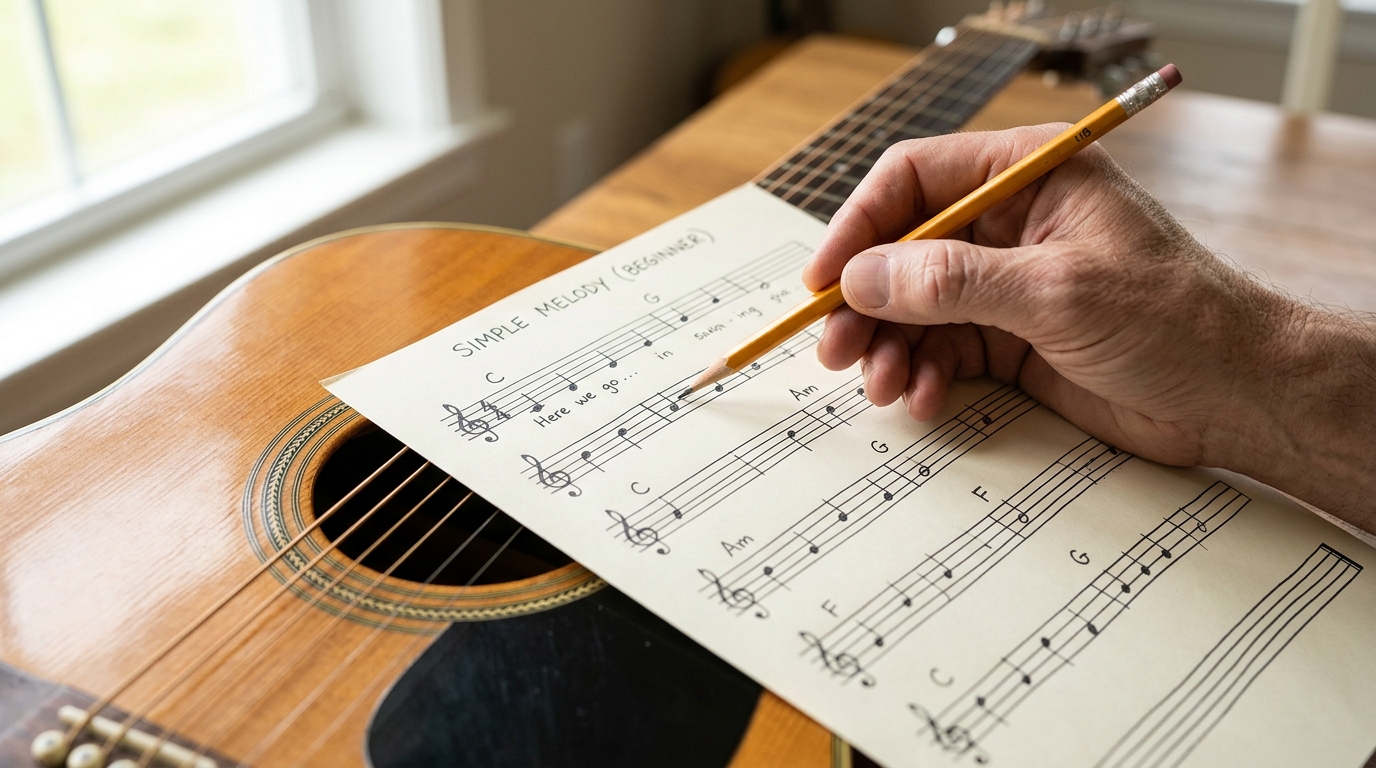
Reading sheet music is incredibly valuable, especially for classical musicians or session players. But it is not strictly required to understand theory. You can understand that a C major chord is made of the notes C, E, and G without ever looking at a piece of sheet music.
If you are a guitarist, you might rely more on fretboard patterns and tabs. If you are a producer using software, you will rely on the piano roll on your screen. Don't let a fear of reading notation stop you from exploring how music works. However, learning the absolute basics of rhythm notation (like quarter notes and eighth notes) is universally helpful.
Common Mistakes When Starting Music Theory for Beginners
If you are diving into music theory for beginners, watch out for these traps:
- Thinking the rules can't be broken. Theory is descriptive, not prescriptive. It tells you what is happening, not what you must do. If a song breaks a theoretical rule but sounds incredible, the song is right, and the rule doesn't apply.
- Ignoring ear training. Theory without ear training is like reading a cookbook without ever tasting the food. If you learn what a "major third interval" is on paper, you must also train your ear to recognize what it sounds like when it's played.
- Getting stuck in the weeds. It's easy to get bogged down in modes, augmented chords, and advanced harmony. If you don't fully grasp understanding music scales and basic major/minor chords first, the advanced stuff will just confuse you.
Frequently Asked Questions
Do I have to learn theory to write songs?
No. Many legendary songwriters, including Paul McCartney and Taylor Swift, rely heavily on their ear and intuition rather than formal theory training. However, knowing theory gives you a massive toolbox. When your intuition fails and you get writer's block, theory provides concrete formulas to help you finish the song.
Where is the best place to start practicing?
Start by learning the names of the notes on your instrument. If you play guitar, memorize the notes on the low E and A strings. If you play piano, memorize where middle C is. If you want a structured online tool to test yourself, we highly recommend using exercises on musictheory.net.
Your Next Steps
Stop looking at music theory as a test you have to pass. It is simply a map that helps you navigate your instrument.
Your next step is to grab your instrument right now and map out the C Major scale (C - D - E - F - G - A - B - C). Play it slowly up and down. Listen to how the notes pull toward each other. By doing this, you aren't just memorizing letters—you are experiencing theory in action.
Once you are comfortable finding those notes, you're ready to start turning them into chords.