

What Is a Time Signature? A Simple Guide for Beginners
If you've ever looked at a piece of sheet music and felt confused by the two numbers stacked on top of each other right at the beginning, you're not alone. The question of what is a time signature is one of the first hurdles every new musician faces, whether you're learning piano, guitar, or vocals.
Those numbers might look like a math fraction, but they aren't asking you to do division. Instead, they are the secret code that tells you exactly how the rhythm of the song is organized. Without them, you wouldn't know when to tap your foot, where the strong beats land, or how fast to play the notes on the page.
Most people overcomplicate this concept when they first start out. In this guide, you'll get the concept of a time signature in music explained in plain English. We won't get bogged down in heavy academic theory. Instead, we'll focus on what those numbers mean for your hands, your voice, and your ears.
By the time you finish reading, you'll know exactly how to look at those two stacked numbers and know what to do next. Let's dive in and demystify the rhythm of your favorite songs.
What Is a Time Signature? (The Top and Bottom Numbers)
When you want to know how to read a time signature, the first step is to stop looking at it like a math problem. The numbers are simply a set of instructions, and they each have a specific job.
The top number tells you how many beats are in each measure. A measure (or bar) is just a small chunk of musical time, separated by vertical lines on the page. If the top number is a 4, there are four beats in every measure. If it's a 3, there are three beats. It's really that straightforward. This number dictates the pulse of the song and tells you exactly how high you need to count before you start over at one.
The bottom number tells you what kind of note gets one beat. This is where people usually get tripped up, but it's easier than it sounds.
- A bottom number of 4 means the quarter note gets the beat.
- A bottom number of 8 means the eighth note gets the beat.
- A bottom number of 2 means the half note gets the beat.
Think of the bottom number as the "currency" of the rhythm. If the bottom number is 4, you are paying for your measures using quarter notes.
When you put them together, a time signature like 4/4 literally translates to: "There are four quarter notes in every measure." A time signature of 3/4 means "There are three quarter notes in every measure."
Pro tip: Don't stress too much about the bottom number if you're just starting. In most popular music, the bottom number will be a 4. Focus on the top number first, because that tells you how the song actually feels when you tap your foot.
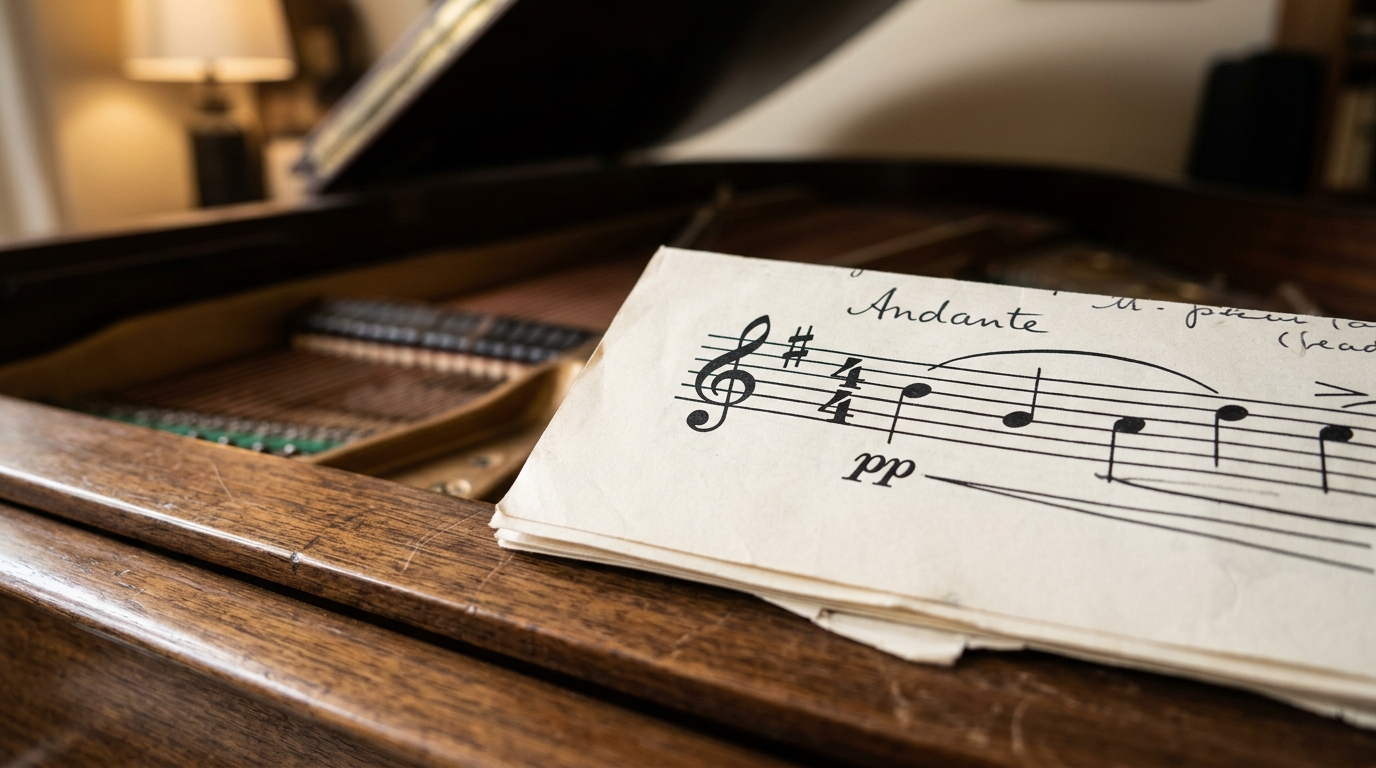
The 4/4 Time Signature Meaning: Why It's Everywhere
If you turn on the radio right now, there is a massive chance the song playing is in 4/4 time. It is so common that musicians literally refer to it as "Common Time," and you'll sometimes see it written on sheet music as a large letter "C" instead of the numbers 4/4.
But what is the 4/4 time signature meaning in practice?
It means every single measure has a steady count of 1, 2, 3, 4. The strongest beat is beat 1, and there's usually a secondary, slightly weaker accent on beat 3. If you listen to a standard rock or pop drum beat, the kick drum (the deep thud) usually hits on beats 1 and 3, while the snare drum (the sharp crack) hits on beats 2 and 4.
This creates a stable, driving, and incredibly natural rhythm. Our bodies love the symmetry of 4/4. We walk in two even steps (left, right, left, right), so a rhythm based on multiples of two just makes physical sense to us. It's perfect for dancing, marching, or just nodding your head in the car.
When you're trying to figure out a song's time signature by ear, your first guess should always be 4/4. Try tapping your foot and counting "1, 2, 3, 4" over the music. If the start of a new phrase or a major chord change keeps landing on your "1", you've successfully identified 4/4 time.
How to Count Time Signatures: Finding the Groove
Understanding the theory is great, but music is physical. You need to know how to count time signatures out loud and feel them in your body.
The secret to counting is consistency. You want the space between each number to be exactly the same. If you speed up or slow down while counting, the time signature falls apart.
When you look at a piece of music, find the top number. That's your ceiling. If the song is in 4/4, you count: ONE, two, three, four, ONE, two, three, four.
Notice how the "ONE" is capitalized? You always want to place a slight emphasis on the first beat of the measure. This is called the downbeat. It anchors the rhythm and keeps you from getting lost. If you're playing with a band and everyone loses their place, a strong downbeat on "one" is how you all sync back up.
Try This Now
Here is a quick exercise to get this into your hands right now:
- Put your phone away and sit up straight.
- Tap your right hand on your leg steadily. This is your beat.
- Count out loud with your taps: 1, 2, 3, 4.
- Make sure your voice gets slightly louder on the 1.
- Now, switch it up. Tap and count to a 3/4 time signature: 1, 2, 3, 1, 2, 3.
Notice how different they feel? The 4/4 feels grounded and square. The 3/4 feels a bit like it's spinning or looping faster. You've just felt the power of different time signatures without touching an instrument.
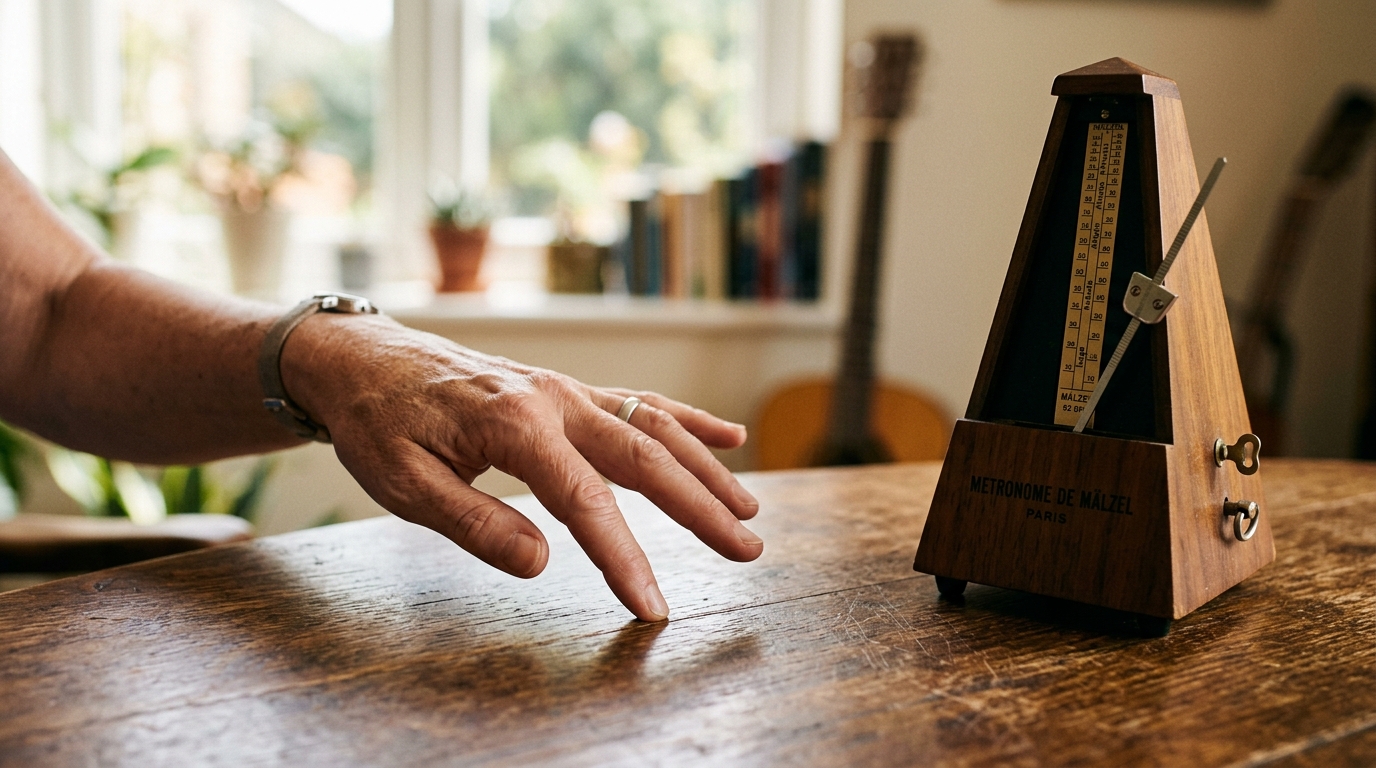
What's the Difference Between 3/4 and 4/4 Time?
If 4/4 is the sound of rock, pop, and hip-hop, 3/4 is the sound of the waltz.
When you count 3/4 time (1, 2, 3, 1, 2, 3), the accent happens more frequently than in 4/4. Because it's an odd number, it doesn't have the same symmetrical "left-right" marching feel. Instead, it has a lilting, circular, swaying motion.
Think of the song "Happy Birthday." It isn't in 4/4 time. If you try to count 1, 2, 3, 4 over it, it feels clunky and wrong. But if you count 1, 2, 3 (Hap-py birth-day to you), it snaps into place perfectly.
Many folk songs, sea shanties, and classical dances are written in 3/4. The easiest way to tell the difference by ear is to listen for the downbeat. If the heavy accent happens every three beats, you're listening to 3/4. If it happens every four beats, it's 4/4.
Odd Time Signatures: Stepping Outside the Box
Once you're comfortable with the basics, you might encounter songs that feel a bit disjointed or unpredictable. These are often written in "odd" time signatures, like 5/4 or 7/8.
An odd time signature simply means the top number isn't easily divisible by two or three. In 5/4 time, you have five quarter notes per measure. Because five is an odd number, the rhythm feels asymmetrical. It essentially forces the listener to stumble forward slightly at the end of each measure before the "one" hits again.
A famous example of 5/4 time is the jazz classic "Take Five" by The Dave Brubeck Quartet, or the original Mission: Impossible theme song. When you count it, it often feels like a measure of 3/4 glued to a measure of 2/4 (1, 2, 3, 1, 2).
While you won't see odd time signatures constantly in mainstream pop or country, they are incredibly common in progressive rock, jazz, and classical music. They exist to create tension and surprise. If you're struggling to count a song that feels like it keeps skipping a beat, you might just be dealing with an odd time signature. Don't panic—just find the downbeat and count how many taps it takes to get back to the start.
Why Does the Bottom Number Matter?
We've talked a lot about the top number, but the bottom number often causes the most headaches. If 4/4 means four quarter notes per measure, what happens if we change the bottom number?
Let's look at 6/8 time. The top number tells us there are six beats per measure. The bottom number (8) tells us that the eighth note gets the beat.
At a glance, you might think 6/8 and 3/4 are essentially the same. After all, if you do the math, six eighth notes take up the exact same amount of musical space as three quarter notes. But remember: time signatures aren't fractions; they are instructions for how the music feels.
In 3/4 time, the beats are usually grouped in three distinct quarter notes. It feels like: ONE, two, three. In 6/8 time, the six beats are typically grouped into two clusters of three. It feels like: ONE, two, three, FOUR, five, six.
It has a galloping, rolling feel to it. Think of the classic blues song "House of the Rising Sun" or Queen's "We Are the Champions." That rolling, swaying momentum is the magic of 6/8 time. The bottom number changed how the composer wanted you to group the notes, completely altering the groove of the song.
If you want to dive deeper into how different note values connect, checking out a resource like musictheory.net can be incredibly helpful for visual learners.
Keep the Beat Alive
Understanding time signatures is the first major step toward truly reading and speaking the language of music. It takes the guesswork out of rhythm and gives you a map for exactly how a song is supposed to move.
Don't let the numbers intimidate you. The next time you listen to your favorite playlist, try tapping your foot and finding the downbeat. Count out loud and see if you can identify whether it's in a steady 4/4 or a swaying 3/4.
Once you get comfortable with the basics, you'll find that reading sheet music becomes significantly easier. If you're ready to take the next step, check out our complete guide on how to read sheet music to start putting these rhythmic concepts together with pitch and melody.
References
[1] Time Signatures Lesson, Music Theory https://www.musictheory.net/lessons/21
[2] Metre (music), Wikipedia, https://en.wikipedia.org/wiki/Metre_(music)
[3] Time signature, Wikipedia https://en.wikipedia.org/wiki/Time_signature